Loading

PX4-native flight controller with hardware-isolated dual IMU and independent I/O processor.
Built around a dual-MCU architecture, triple-redundant power system, and a 6-layer PCB with dedicated ground and power planes for demanding autonomous platforms.
PX4-compatible • USB-C • Dual IMU • FRAM-backed params
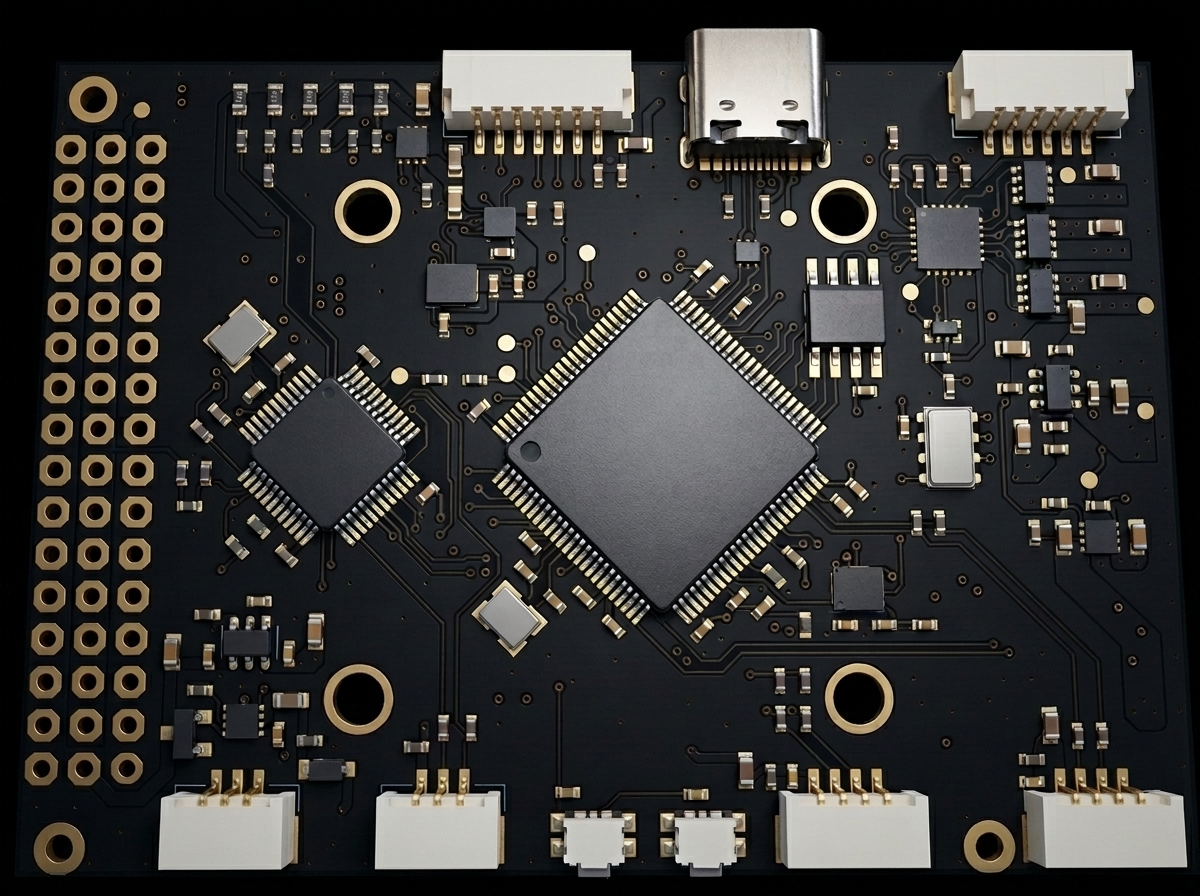
Engineering decisions that separate ARIADNE from commodity flight controllers
Dedicated ground and power planes, not just routing layers
Dedicated ground and power planes keep digital switching noise away from analog sensor traces, and physically separate IMU buses mean a fault on one sensor path can't couple into the other.
Independent brick, servo rail, and USB power inputs
Your vehicle maintains control authority even when a power rail fails — critical for operations over populated areas or expensive payloads.
STM32F765VIT6 flight processor + dedicated STM32F1 I/O processor
If the flight management unit encounters a fault, the IO processor can independently execute failsafe procedures — motor shutdown or return-to-land.
Dedicated UART wired for ExpressLRS out of the box
Modern ELRS receivers plug in directly with no adapter, while the IO co-processor keeps legacy PPM/SBUS/Spektrum receivers fully supported.
Two processors, clear responsibility boundaries
STM32F765VIT6
Flight Management Unit
STM32F100C8T6
IO Co-Processor
Connected via USART6 · Independent reset domains · Separate power regulation
Design decisions that matter in the field
Each IMU operates on a dedicated SPI bus. A fault on one sensor path cannot propagate to the other — true electrical isolation, not just software redundancy.
Modern connector with reversible insertion and robust mechanical retention. Panel-mount compatible for enclosed airframes where access is limited.
GH1.25 series connectors with shield across every port — USB-C, TELEM, GPS, RC, and power — rated for vibration environments, the same standard used throughout the PX4 ecosystem.
4-bit SDIO interface provides sustained write throughput for high-rate logging. No data loss during aggressive maneuvers or rapid attitude changes.
Transparent progress from concept to production
The board ships bare from JLCPCB, then moves through bring-up, bench validation, and flight testing before production. The status above updates as each stage is reached.
Part of the TH3SEUS Ecosystem
First-class HITL simulator integration — configure, tune PIDs, and validate your build before first flight.